Reliable AI for precision oncology.
This is EGFR L858R (c.2573T>G, p.Leu858Arg), a well-known activating mutation in exon 21. It confers sensitivity to EGFR tyrosine-kinase inhibitors such as gefitinib, erlotinib, and osimertinib. Classified as oncogenic; corresponds to COSMIC ID COSM6224 and is typically Tier IA.
- HGVS
- NM_005228.5:c.2573T>G
- protein
- p.Leu858Arg
- tier
- ESCAT I-A
- cite
- CIViC EID275 (Level B)
- region
- FDA (US) · EMA (EU)
last updated 2026-07-13
Clarus stays consistent while General AI drifts
Illustrative examples, not medical advice.
Conforms to
- VariantValidator
- CIViC
- ClinVar
- gnomAD
- Genome Nexus
- UniProt
- HL7 FHIR
- mCODE
- LOINC
- SNOMED CT
- HGNC
- ClinicalTrials.gov
How it works
A framework you can trust.
Traceable, inspectable, auditable.
- 01
ingest
Raw sequencing output or PDF, with the reference build (GRCh38) confirmed.
- 02
classify
Oncogenicity by VICC / CGC criteria, not model opinion.
- 03
actionability
ESCAT tier and matched therapy, cited to a CIViC evidence item.
- 04
validate
Every LOINC / SNOMED CT / HGNC code resolved against the terminology validation.
- 05
assemble
mCODE-conformant FHIR GenomicsReport.
Human validation
Every report is signed by a human.
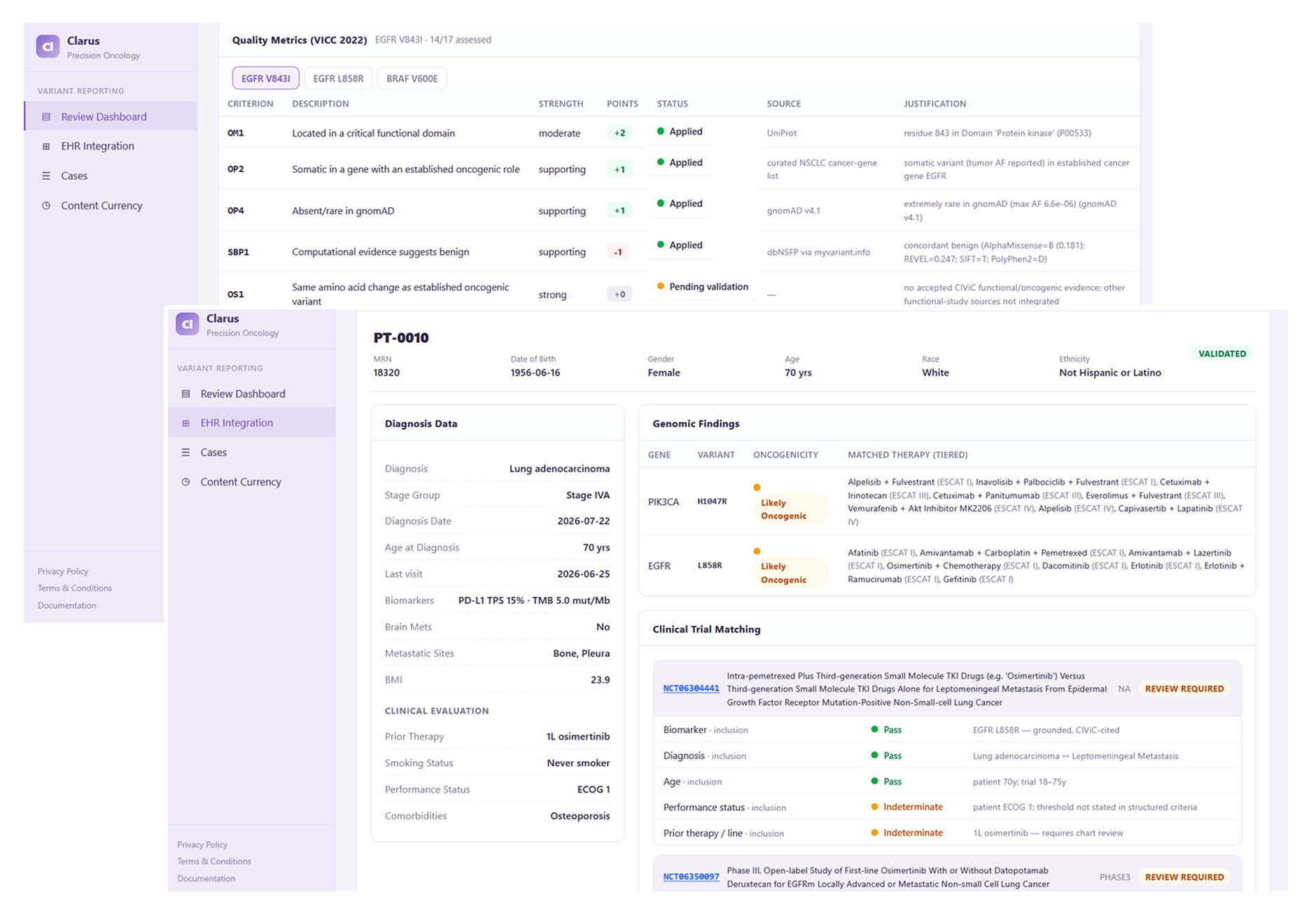
The reviewer sees each criterion and its justification, then accepts or flags it. The report only leaves the system once a person has signed it.
Dual-audience
Built for labs and agents.
Use it as a building block, we set it up with you.